
More than 5,000 Larimer County residents receive behavioral health crisis care at Longview each year.
Longview offers urgent stabilization and short-term inpatient care for people in mental health or substance use crises.
Access & Community Need
Level of Care & Clinical Complexity
System Impact
Data Transparency



Expanding Access to Behavioral Health
Crisis Care in Our Community
Nurses, family medicine physicians, therapists, addiction specialists, peer specialists, pharmacists, and more, work as one to provide higher levels of care that weren’t previously available in one place in Northern Colorado. Behavioral health urgent care, withdrawal management, crisis stabilization, fitness center, pharmacy and more – Longview has it all in one place.
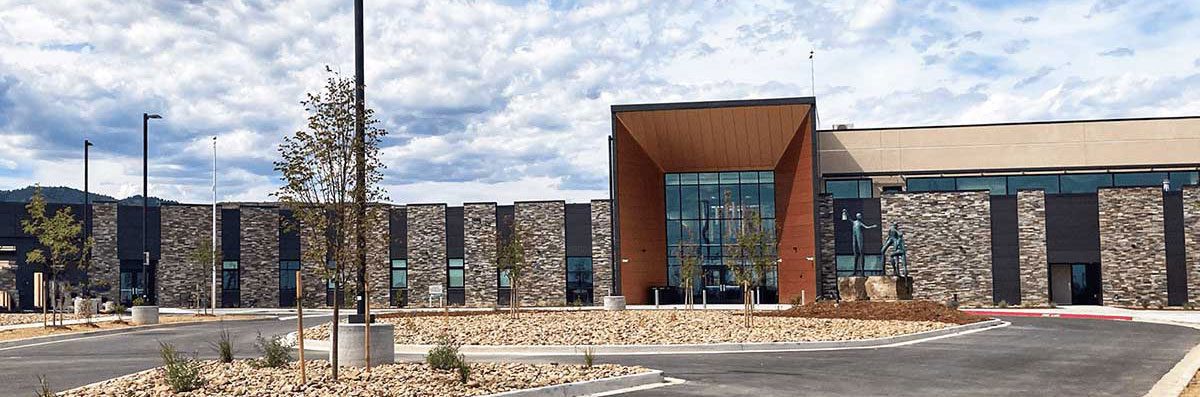
The Acute Care facility opened its doors to the community on Dec. 2, 2023 and represents a unique public-private partnership between Larimer County and longtime nonprofit SummitStone Health Partners, which is contracted to provide services.
Read Longview’s Guiding Light & Care Philosophy
Longview Guiding Light & Care Team Compact
Who will we get to see today?
As behavioral healthcare professionals choosing to serve as SummitStone employees at the Longview Acute Care Facility, we commit this compact as our guiding light.
Our Foundation
This facility was conceived by our community’s strong desire for critical behavioral health services and born of our community’s commitment through sales tax dollars. It is a truly special partnership.
This facility will have a legacy driven by the clients who experience our services and the community who make the funding possible, a legacy that will endure far beyond our time here.
Every interaction matters.
We are committed to working in teams grounded in the following:
Every interaction we have with our clients makes a difference. How we show up matters, recognizing and respecting our clients are fully formed persons with agency in every encounter. We are passengers on the journey of our clients in the recovery they desire.
We serve as supportive guides, as light posts along the way. We respect our role as witness and passenger to the beautiful change and progress that happens in our care, not drivers.
Our Clinical Commitment
We are committed to harm reduction in all its forms.
Our clients enter and leave our care under various circumstances. Some will come in handcuffs, some under supervision of the state, some under threat of divorce or family separation, some with extreme dysregulation, and others still under their own choice to seek help.
Some will leave after successful completion of their treatment plan, after lots of conflict and resistance, after 1 visit or 72 visits. Regardless, we honor the choice they made to stay for as long as they did, the work they did while they were here, and their desire for change.
We Serve Our Community
The people we serve represent tremendous resolve and resilience in the face of life’s starkest challenges, many of which result from our society’s greatest systemic inequities. Despite these, our clients live full lives. They are painters, construction workers, lawyers, engineers, homemakers, store clerks, business owners, cooks, therapists, peers, doctors, case managers, and so much more. They are our parents, our siblings, our children, our neighbors, our community.
We commit to staying curious about the people we get to see each and every day at Longview.
Our measure of success will not be how many leave us on the path to recovery, but more in how safe we make them feel, how we listen to their stories and needs, and how we care for them while they are with us.
We mark their leaving with gratitude, respect, and an unconditional invitation to return if and when they need us.
Who will we get to see today?
The Longview Team
Longview at a Glance (2024–2025)
14,995
Urgent Care Visits
~80%
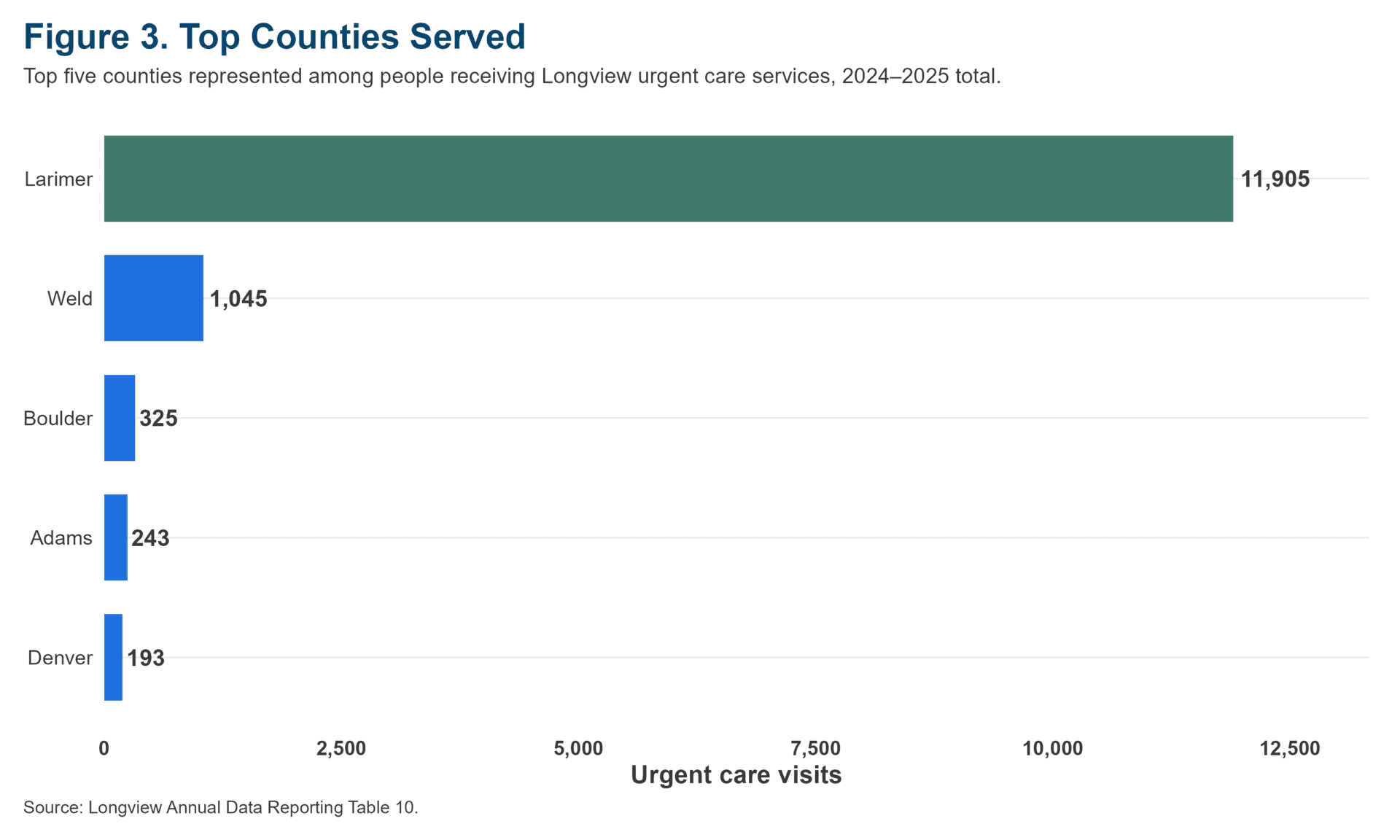
Clients from Larimer County
1,200+
Youth Served – Supporting children, adolescents, and their families in crisis.
Everyone Arriving at Longview is in a Behavioral Health Crisis
Longview serves individuals experiencing acute behavioral health crises requiring immediate evaluation and stabilization.
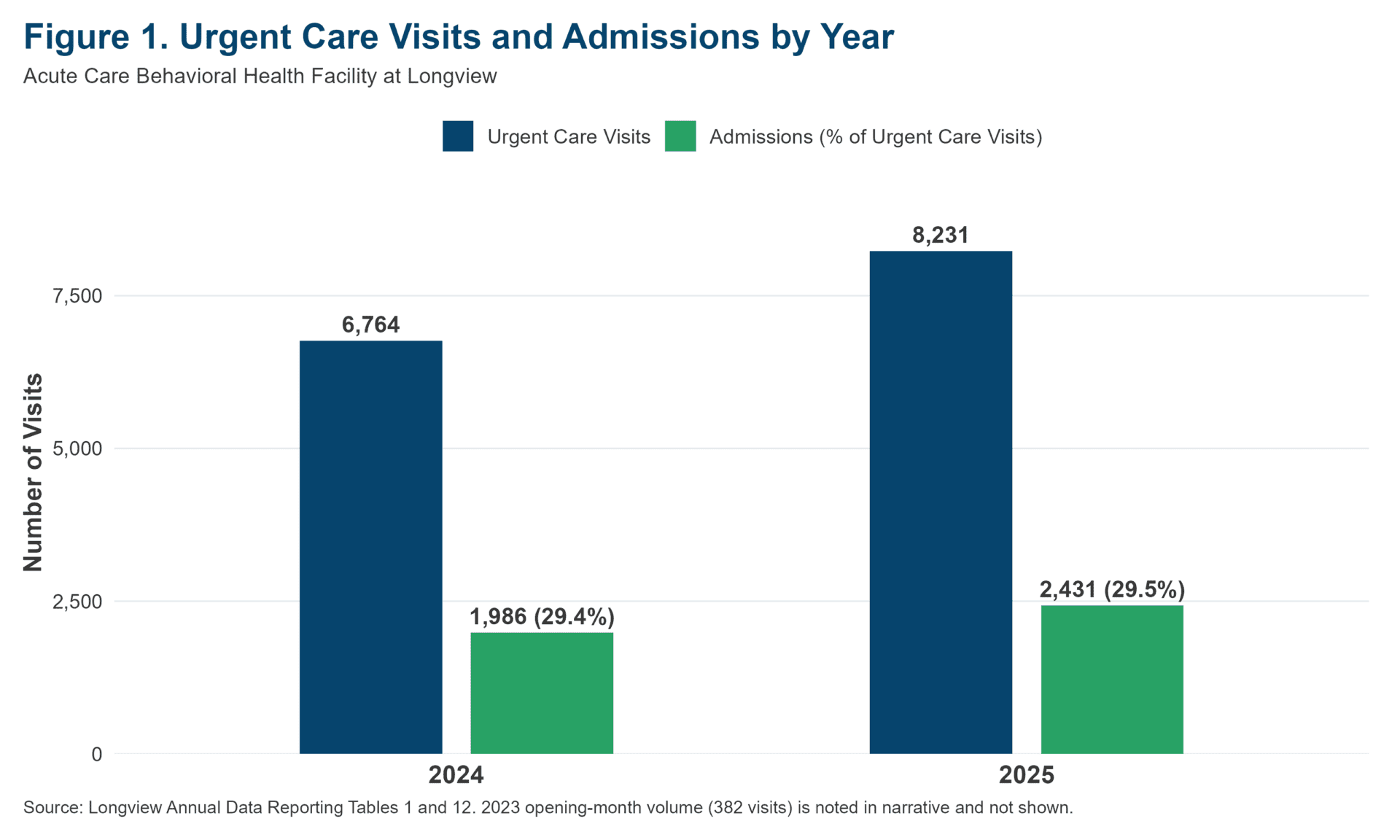
Urgent care visits increased from 6,764 in 2024 to 8,231 in 2025, reflecting both growing community need and increased awareness of available services.
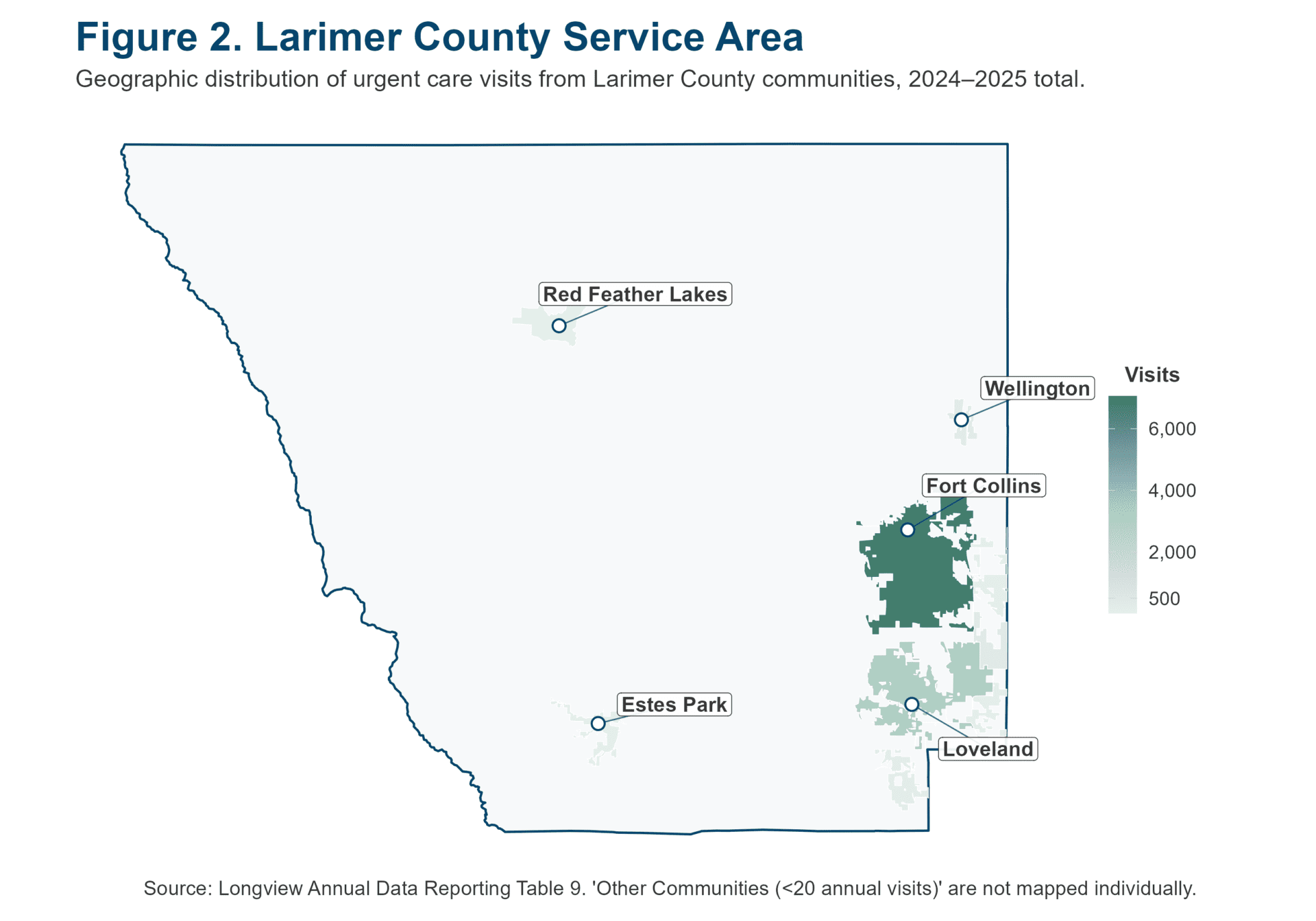
The majority of clients reside in Larimer County, with a minority coming from other parts of Northern Colorado.
Longview operates 37 of 56 planned beds, expanding in stages to meet community need. In December 2025, it opened an Adolescent Crisis Stabilization Unit for ages 12–17. The remaining beds are scheduled to open by mid-2026.
Providing Integrated Care for
Complex Behavioral Health Needs
Behavioral health crises rarely occur in isolation — most involve overlapping mental health and substance use needs. Longview is designed to meet people where they are. Care is tailored to each client’s clinical needs.
Most people are stabilized through Longview’s walk-in urgent care services, which offer quick assessment and crisis support.
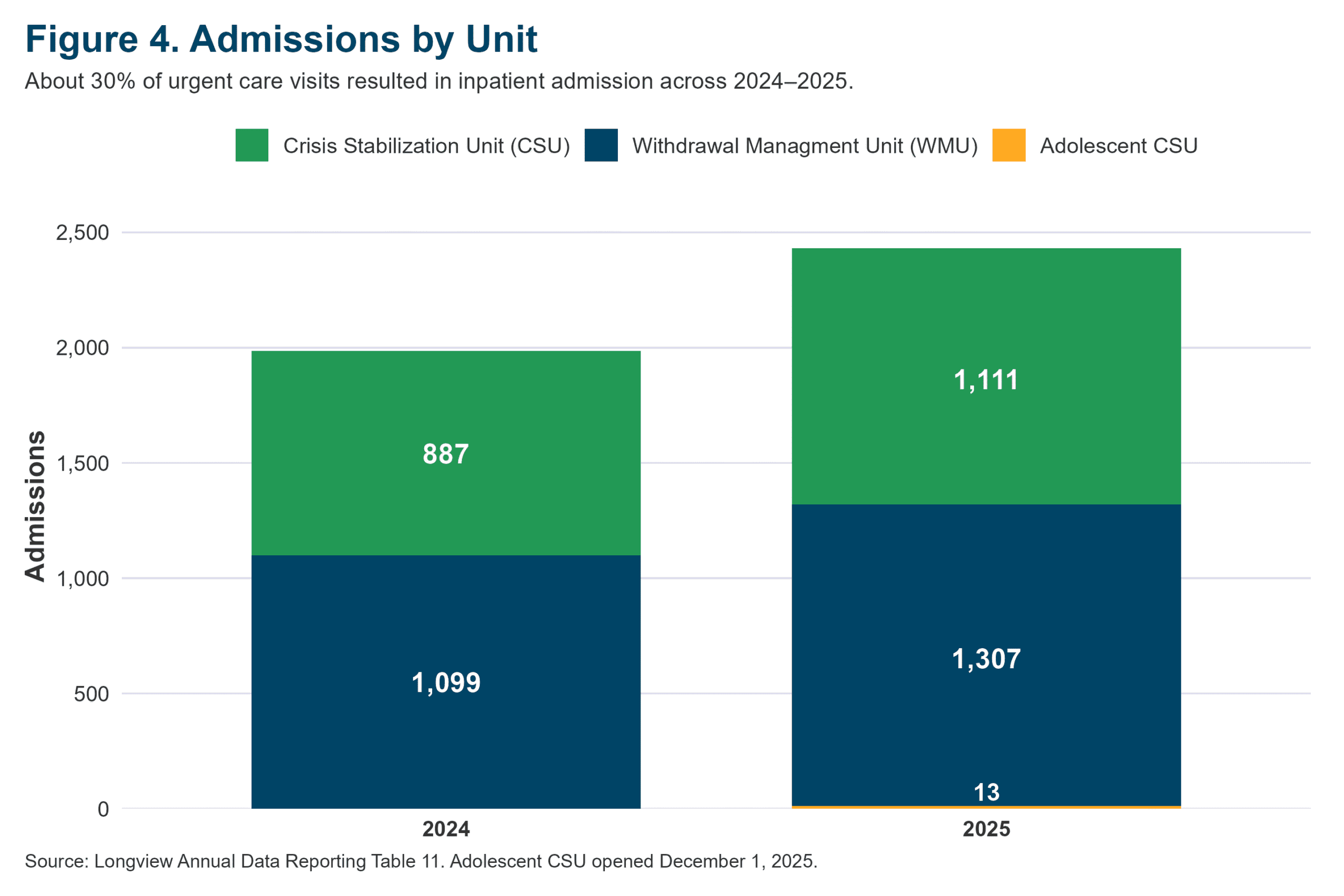
About 30% of urgent care visits result in admission for short-term inpatient stabilization. Clients may be placed in:
- Crisis Stabilization Unit (CSU) for acute mental health care
- Withdrawal Management Unit (WMU) for medically supervised withdrawal
Alcohol withdrawal accounts for most withdrawal management admissions, with stimulant and opioid conditions following.
Alcohol
60%
Stimulants
36%
Opioids
19%
Other
51%
Shifting Crisis Care from Emergency Departments to Specialized Behavioral Health Care
High-Acuity Stabilization in a Purpose-Built Setting
Longview offers a behavioral health option for people in crisis instead of emergency rooms or jail.
By delivering specialized stabilization in a purpose-built clinical setting, Longview helps ensure individuals receive appropriate behavioral health care while reducing strain on other community systems.
In 2 years, Longview provided additional crisis care for:
Mental Health
13,012
Visits
SUD
8,317
Visits
High Safety Risk
4,285
Visits
Comparison of behavioral health utilization between Longview urgent care services and county emergency department visits.
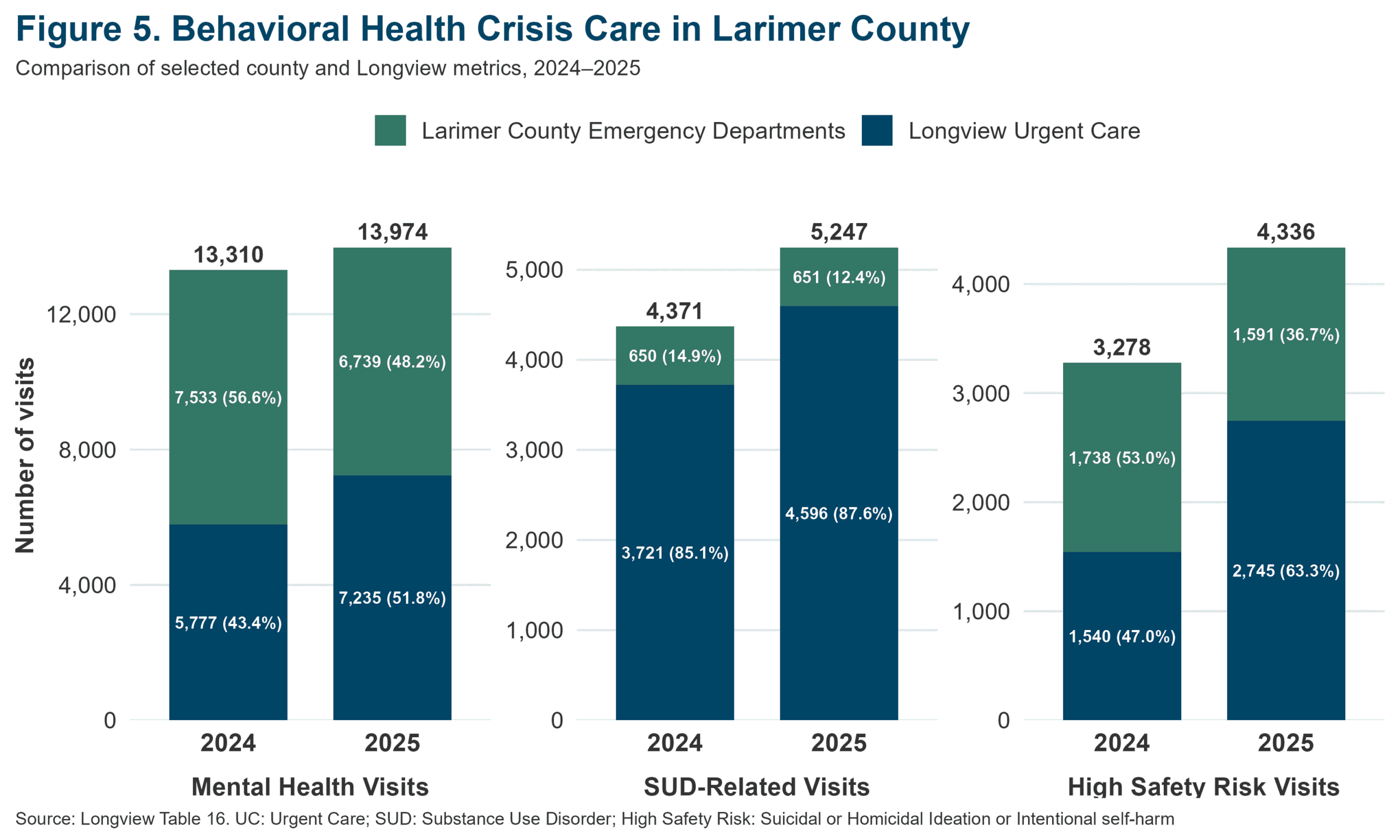
For mental health visits, emergency departments in the area showed a decreasing visit trend with 7,533 visits in 2024 and 6,739 visits in 2025. By contrast, Longview Urgent Care visits increased from 5,777 to 7,235 over the same time period, surpassing emergency department volumes in 2025.
For SUD-related visits, Longview Urgent Care had substantially higher volumes, increasing from 3,721 in 2024 to 4,596 in 2025. Emergency department SUD visits remained low and stable, with 650 visits in 2024 and 651 in 2025.
For high safety risk encounters, Longview Urgent Care volumes increased markedly from 1,540 in 2024 to 2,745 in 2025. Emergency department encounters were lower and slightly decreased from 1,738 to 1,591 over the same period.
Overall, the figure demonstrates a shift in behavioral health crisis care utilization toward Longview Urgent Care, particularly for substance use and high-acuity safety risk presentations, while emergency departments continue to see higher but declining mental health visit volumes. Source references table 16 in the Longview Annual Data Reporting PDF linked on this site.
Data Transparency
Longview is committed to responsible public reporting of service utilization and community impact. Data presented on this page reflect the most recently completed reporting period.
Privacy & Data Suppression Practices
To protect the privacy of individuals receiving care:
- Data are reported in aggregate form only
- No individual-level information is displayed
- Categories with fewer than 20 individuals may be suppressed or grouped
- Percentages may not total 100% due to rounding or overlapping clinical categories
These practices ensure meaningful transparency while protecting client confidentiality.
Download Full Annual Data Tables (PDF)
The downloadable report contains the full reporting tables for Longview urgent care visits and admissions, including demographic, diagnostic, and community utilization data.